
How To Rapidly Learn Any New Skill You Want
Whether it's chess, guitar, or juggling, this simple framework will help you learn any new skill with ease.

Hi there fellow book lover! 👋
Welcome to The One Percent Better Club 📚 - your weekly dose of brilliant ideas from the world’s best nonfiction books that are going to help you be one percent better today than you were yesterday! This week, I’m talking about the book Ultralearning by Scott Young. So if you’re ready for that one percent upgrade, then let's dive in! 🚀
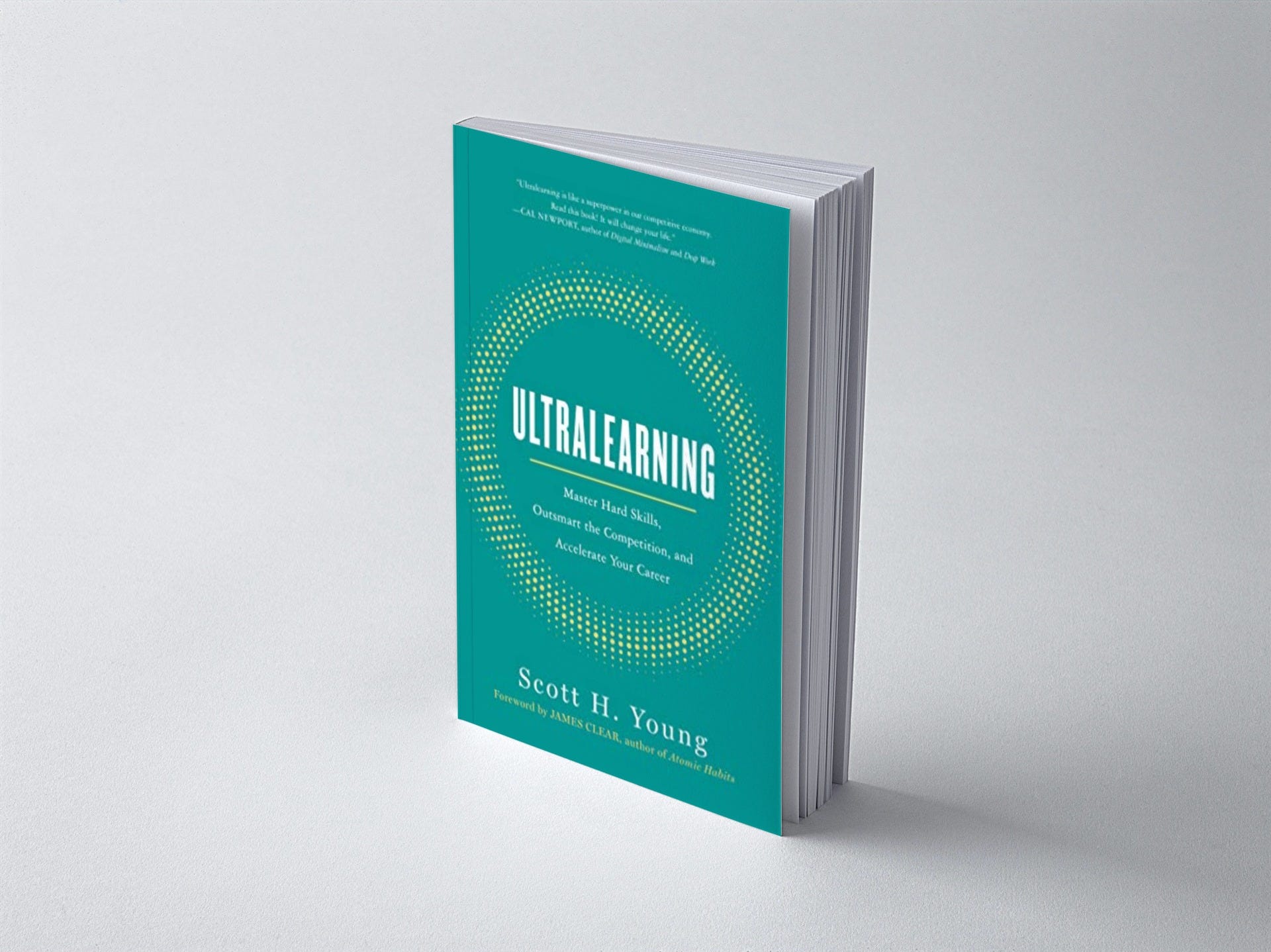
So what exactly is “Ultralearning”?
Well, in the book Ultralearning, bestselling author and rapid learning expert Scott Young says,
“Ultralearning is a strategy for acquiring skills that is both self-directed and intense.”
Here are a few ultralearning examples that Scott Young gives in his book:
Benny Lewis — who is fluent in a multitude of languages and who achieved fluency in German in just 3 months.
Roger Craig — who won $77,000 in Jeopardy in a single day by aggressively preparing for the show.
Eric Barone — who made his own video game by learning game development, musical composition, pixel art, sound design, and writing all on his own.
All of these people took unusual steps to maximize their effectiveness in learning new skills.
That’s what made them ultralearners.
And Ultralearning author Scott Young is no different.
In 2014, Scott Young accomplished an ambitious project. He completed the MIT undergraduate computer science curriculum at 4x speed.
Instead of the typical 4 years it normally takes to complete, he passed all final exams in less than 12 months!
But how did Scott do it?
How did Benny Lewis, Roger Craig, and Eric Barone do it?
In the book Ultralearning, Scott Young shares the exact structured plan he used (and that you can use) to rapidly learn any new skill you want.
Here are the 3 best ideas (plus 3 bonus ideas if you’re a paid subscriber) that Scott Young gives in his book Ultralearning:
Let’s dive in!
💡 Idea #1) Figure Out The Map
Because you’re reading this book summary, chances are you’re interested in quickly learning a new skill.
But no matter what it is you want to learn, the question is, where should you start?
While it’s tempting to just randomly learn everything there is to know about your desired skill, it’s much better to be strategic with how you learn it.
In other words, you first need to figure out what the fastest and most efficient way to learn your skill is.
In the book Ultralearning, Scott Young says that if you want to learn a new skill quickly, then stop thinking you have to learn every single aspect of that skill.
Why? Because learning everything about a skill would feel overwhelming and be counterproductive.
Instead, break up the skill you want to learn into a set of sub-skills that you can learn individually.
If you don’t know what sub-skills are, sub-skills are essentially small skills that make up a larger skill.
Let’s use chess as an example…
Playing chess is a skill that has many subcomponents to it: the opening, the middle game, the endgame, etc.
Even those sub-skills can be broken down into smaller sub-skills. The opening, for example, can be broken down into the Ruy Lopez, the French Defense, the Sicilian, etc.
But here’s the thing…
Most sub-skills are unimportant.
Typically, only a few sub-skills are actually worth learning.
In relation to chess, the Ruy Lopez is one of the most played and most effective openings in chess.
Because of this, learning the Ruy Lopez is definitely worth more of your time and effort than learning some random opening that you’ll never see played or that gets beaten easily.
So if you want to learn a new skill, always deconstruct it into a set of sub-skills and then try to identify which sub-skills are the most important.
Once you’ve done that, invest all your time and energy into learning those sub-skills first.
By focusing on the critical sub-skills first, you’ll make a lot more progress with far less effort.
💡 Idea #2) Be Direct While Learning
Unfortunately, in most situations where you’re trying to learn something, theoretical learning is often not going to help you improve.
Why? Because theoretical learning such as reading a book, listening to a podcast, or watching a video is often so distant from the actual skill you want to learn.
In the book Ultralearning, Scott Young calls this type of learning “Distant Learning.”
But here’s the thing…
According to Scott, you want to focus on “Direct Learning,” which is the practice of learning something by directly doing the thing you want to learn.
Essentially, it’s improvement through active practice rather than through passive learning.
Practice > Learning
It might not seem like there’s a difference between learning something new and practicing something new, but there is.
A huge difference…
Yes, learning something new can give you new knowledge. But only practicing something new can create a new skill.
For instance:
You can research the best instructions on the bench press technique, but the only way to build strength is to practice lifting weights.
You can read all of the bestselling books on sales, but the only way to get better at attracting customers is to practice making sales calls.
You can go through all the fun language-learning apps you want, but the only way to learn a language is by conversing with actual people in the language you’re trying to learn.
In this book, Scott Young fully clarifies this point:
“Learning can be very useful, of course, but the danger of simply soaking up new facts is that it can be very disconnected from the process of learning a new skill itself. You can know every fact about an industry and still lack real-world expertise because you haven’t practiced the skill.”
Therefore, don’t spend your time on tasks that are distant from the skill you want to learn.
Instead, foster a bias towards direct action and spend a lot of time directly doing the thing you want to become good at.
💡 Idea #3) Identify Your Bottlenecks
In chemistry, there’s a simple concept known as “The Rate-Determining Step.”
This concept usually appears when there’s a chemical reaction that takes place over multiple steps, with the products of one reaction becoming the reagents for another.
Essentially, the rate-determining step is the slowest part in this chain of reactions, which forms a bottleneck that ultimately defines the amount of time needed for the entire reaction to occur.
In the book Ultralearning, Scott Young says that learning often works the same way.
Whenever you’re trying to learn a new skill, there are always going to be certain steps in your learning process that form a bottleneck, which ultimately controls the speed at which you can learn a new skill.
For example, if you want to learn a new language, a bottleneck could be the amount of vocabulary you know.
The number of sentences you can successfully speak directly depends on how much vocabulary you know.
If you know too few words, then you sadly won’t be able to talk about very much.
However, if you were able to suddenly inject hundreds of new words into your mental database, then you would drastically expand your fluency even if your pronunciation, grammar, and other linguistic knowledge stayed the same.
So whether it’s learning a new language or something else, bottlenecks can make it hard to quickly improve.
So whenever you’re trying to learn a new skill, identify your bottlenecks and then work tirelessly on improving them.
💡 Idea #4) Attack Attack Attack
Keep reading with a 7-day free trial
Subscribe to The One Percent Better Club 📚 to keep reading this post and get 7 days of free access to the full post archives.